Sustainability

Our sites run on real renewable power, measured and reported — not offset away.

Sustainability at GreenGridLabs is not an add-on narrative. It is the reason the facilities exist in the Nordics in the first place, and it sets the constraints every engineering decision has to respect.

Principles

Three commitments that shape every site.

We can defend each of these in front of a regulator, an auditor, or a customer's sustainability officer. They are not marketing claims.

1

Physical renewables, not certificates

Every operational site is powered through physical PPAs or on-site generation — wind, hydro or solar. We do not build a sustainability story on top of unbundled renewable energy certificates bought on the open market.

2

Low PUE by design

Nordic climate plus purpose-built thermal envelopes let us target PUE well below 1.20. Free-air and indirect evaporative cooling do most of the work; chillers are the exception, not the rule.

3

Heat recovery where it matters

Where local district heating networks can absorb waste heat, the site is designed for connection. Datacenter heat is useful thermal energy — treating it as waste is the mistake.

Efficiency & transparency

What we design for.

Our sites are engineered around a small number of efficiency principles. Where customers or regulators request facility-level data, we provide it on a contractual basis.

01

PUE

Design target below 1.20, achieved through Nordic free-air cooling, purpose-built thermal envelopes and minimal mechanical overhead.

02

Minimal water usage

Free-air and indirect evaporative cooling reduce water consumption to a fraction of what conventional chiller-based designs require.

03

Renewable sourcing

Electricity is procured through physical PPAs with Nordic renewable generators — wind, hydro and solar — not through unbundled certificates.

04

Heat recovery

Where a local district heating network or industrial offtaker can absorb it, waste heat is designed into the site from day one rather than rejected to the atmosphere.

Waste heat

A datacenter is a year-round heat source. We treat it like one.

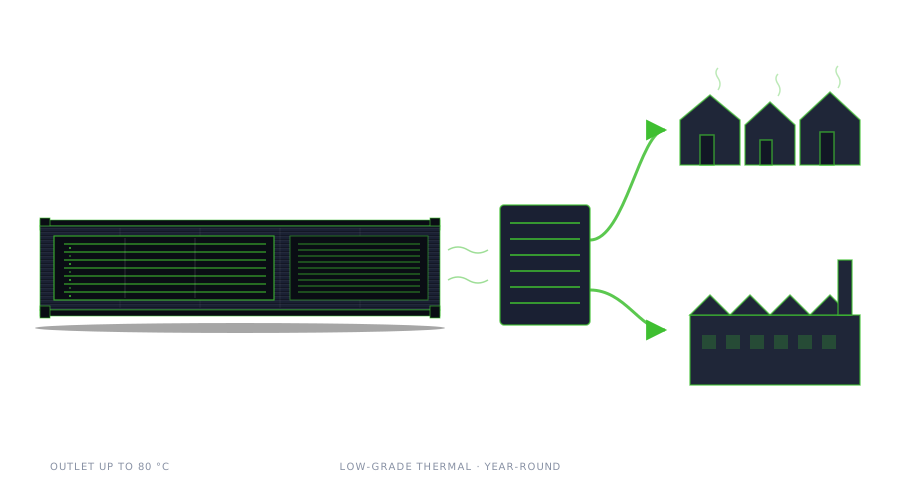
Every megawatt that leaves a server rack comes back as low-grade thermal energy. In a Nordic town, that is not a disposal problem — it is winter heat a neighbour can use. We design the offtake path into the site from the first line drawing.

Schematic: a containerized datacenter feeds a plate heat exchanger, which delivers thermal energy to a district heating network and an industrial offtaker.
Dalsbruk, Finland

One site, two potential thermal offtakers nearby.

The Dalsbruk site sits on the edge of the Ovako steel-wire plant at Brukviken, with a municipal district heating network a short pipe run away. That proximity is the reason we chose the location — the thermal profile of the compute load lines up with what the industrial neighbour and the local heat network can actually absorb.

The heat path is simple. A plate heat exchanger on the compute side transfers energy into a low-temperature water loop, and from there into whichever offtaker is calling for heat. Nothing exotic, nothing that needs to be invented for this site — and the offtake arrangement is being finalised with the local partners in parallel with commissioning.

Why it matters

A datacenter designed to heat the town it sits in.

Heat recovery changes how a datacenter sits in its local landscape. Instead of rejecting thermal energy to the atmosphere and asking the town to burn fuel for its own heating, the same kilowatt does two jobs — it runs the workload inside, and it warms a school, a factory or a municipal building next door.

That is a better outcome for the town, a better outcome for the customer's sustainability profile, and — when the offtake is there — a better effective-PUE than any cooling optimisation can deliver on its own. It is one of the reasons we build in the Nordics in the first place.

Honesty clause

What we don't claim.

We don't claim to be carbon-negative. We don't claim that every kilowatt-hour flowing through our facilities is somehow greener than the grid average. We don't rely on voluntary offsets to make a net-zero assertion.

We do claim that the electrons we buy come from renewable generation we have contracted and that we measure what we use. That is a deliberately narrower, more defensible claim than the sector average — and we think that is the point.